Showing posts with label Ewa Hawaii. Show all posts

Friday, July 11, 2014

Hawaii State Legislature, 2009, HCR49 PRESERVATION OF UNITED STATES MARINE CORPS AIR STATION EWA

Great News!

Ewa Field Battlefield Determination of Eligibility (DOE)

 by the National Park Service in Washington, DC


Hawaii State Legislature, 2009, HCR49 HD1

URGING PRESERVATION OF UNITED STATES MARINE CORPS AIR STATION EWA
 AS A NATIONAL MONUMENT, MUSEUM, AND RESTORED PARK 
FOR THE STATE OF HAWAII

The purpose of this concurrent resolution is to urge the President of the United States (U.S.), Secretary of Defense, and Secretary of the Interior to preserve Marine Corps Air Station Ewa, or a portion of it, as a National Monument.

     The Department of Land and Natural Resources, Historic Hawaii Foundation, and concerned individuals supported this concurrent resolution.

     Your Committee has amended this concurrent resolution by:

(1)  Requesting that the U.S. Navy and its private, public and nonprofit partners to proceed with the research, battlefield analysis, and other activities necessary to designate an appropriate boundary within Ewa Field for nomination to the Hawaii State and National Registers of Historic Places;

(2)  Requesting the Department of Land and Natural Resources to report to the 2010 Legislature on these activities;

(3)  Including the U.S. Navy in the list of persons urged to preserve the Marine Corps Air Station Ewa;

(4)  Including the Commander of Navy Region Hawaii in the list of persons who are to receive a certified copy of this concurrent resolution;

(5)  Making other amendments to conform this concurrent resolution to these amendments; and

(6)  Making technical, nonsubstantive amendments for clarity, consistency, and style.

     As affirmed by the record of votes of the members of your Committee on Economic Revitalization, Business, & Military Affairs that is attached to this report, your Committee concurs with the intent and purpose of H.C.R. No. 49, as amended herein, and recommends that it be referred to the Committee on Water, Land, & Ocean Resources in the form attached hereto as H.C.R. No. 49, H.D. 1.

Respectfully submitted on behalf of the members of the Committee on Economic Revitalization, Business, & Military Affairs


*****************************************************************
5/6/2009 S Report and Resolution Adopted. Transmitted to House.
5/6/2009 H Resolution adopted in final form.
******************************************************************

 URGING PRESERVATION OF UNITED STATES MARINE CORPS AIR STATION EWA
 AS A NATIONAL MONUMENT, MUSEUM, AND RESTORED PARK 
FOR THE STATE OF HAWAII


http://ewafield.blogspot.com/

http://barbers-point.blogspot.com/

http://ewabattlefield.blogspot.com/

http://ewa-battlefield-nomination.blogspot.com/

https://www.facebook.com/Save-Ewa-Field-270728152937385/

Draft Ewa Plains Battlefield Nomination And Photo Archive Available:

'Forgotten​' Sacrifice Honored In West Oahu


Thursday, August 8, 2013


Preserving 'Ewa Marine Corps field

an uphill struggle


By William Cole Advertiser Columnist   June 30, 2008

'Forgotten' Sacrifice Honored In West Oahu


'Ewa Beach resident John Bond hasn't given up on his struggle to gain preservation of Marine Corps Air Corps Station 'Ewa, one of the first battlefields of U.S. involvement in World War II on Dec. 7, 1941, but he knows he's up against some powerful players with other ideas.

"Despite the recommendations that the 'Ewa Marine Corps Air Field qualifies for the National Historic Register, qualifies for national monument status, qualifies for national battlefield status and the National Battlefield Protection Program," Bond said, the Navy has other plans.

Japanese Zero fighters strafed the nearly 50 Marine aircraft at 'Ewa Field before the first raid on Pearl Harbor minutes later. Four Marines were killed during three waves of attacks.

Joel Fujita, who's now 88, remembers being on the roof of his parents' 'Ewa Plantation home about 50 yards from the base front gate. He and three brothers climbed up on the roof to see what they initially thought was a training exercise.

"A Zero fighter came over. You could see the canopy open," Fujita said. "He was waving to us, so we waved back, and about five minutes later, a plane came back and started to strafe in front of our house."

Bond, an amateur historian who has done a lot of research into 'Ewa Field, said he's pursuing a suggestion from Pearl Harbor survivor Ray Emory, who was onboard the USS Honolulu, for 'Ewa Field to become a new national veterans cemetery.

The National Memorial Cemetery of the Pacific at Punchbowl has no more space for in-ground burials.

Bond is trying to rally last-minute support as the Navy, which owns the 'Ewa Field land, finalizes plans to lease to Ford Island Properties 499 acres for 40 years with an option to take title to the property.

A chunk of that land includes the old 'Ewa Field runways.

The Navy said the lease still is being negotiated, with an agreement expected by the end of August. Ford Island Properties is part of the Hunt Development Group.

Steve Colon, president of the Hawai'i division of the Hunt Development Group, previously said in a statement that the Kalaeloa land "offers an opportunity to create needed jobs near the urban center of Kapolei," but added that specific plans had not been made for its use.

Bond believes Hunt will build shopping centers and expensive homes on the land, which abuts Barbers Point Golf Course.

The Navy had said 4 to 5 acres at the center of the old runways are eligible for listing on the National Register of Historic Places, but Bond wants a bigger chunk of the old base preserved.

There's not much left to see of the airfield, with only foundation outlines, a Quonset hut and concrete building or two standing, but the original runways are still there. Dozens of arched concrete aircraft revetments remain on a separate portion of the base.

Bond's development concerns for the area are evident in plans like the final lease agreement that recently was signed to bring as a neighbor to 'Ewa Field a big shopping center.

The agreement was announced by the state Department of Hawaiian Home Lands and the Tampa, Fla.-based Hawai'i DeBartolo LLC. The center, called Ka Makana Ali'i, will have 1.6 million square feet of commercial space.

Fujita recalls a very different time, when Marines in 1941 used to walk over and wait in the family's front yard for the bus to town.

"We had four good friends, Marine pilots, and we used to do their laundry," Fujita said.

He also remembers during the Dec. 7 attack a Marine wounded and in bandages coming into the street with a rifle looking for Japanese infiltrators.

Larry Galola wrote in to say photos of the concrete aircraft revetments brought back memories of when they were used as bomb shelters for elementary students during the early 1950s.

"I attended Barbers Point Elementary School back then and it was located on the edge of the airfield. During the Cold War bomb drills we walked to those revetments and took shelter there," he said. "I also recall exploring all the old abandoned WWII bunkers as a kid living on base."


Group wants to save WWII history from demolition
By Zahid Arab Jun 08, 2008


EWA BEACH (KHNL) - Many here in Hawaii and around the country can never forget the Japanese attack on Pearl Harbor. That deadly ambush, killed thousands and has been immortalized in pictures and film. But now a local group says an important area involved in the attack is in danger of being destroyed. 

It's a place where many marines lost their lives after a steady Japanese attack.

The Ewa Marine Corps Air Field has been untouched since the war and while some consider it forgotten, others call it a fixture in American history.

  "They basically shot up all of the planes that were right here. Destroyed most of them and then continued onto Pearl Harbor," said John Bond.

Historian John Bond says the old Ewa Field is often confused with Barbers Point Naval Air Station.

  "As the planes kept coming in and bombing different fields and everything they would come back to this area rotate and then keep shooting everything that moved," Bond said.

Once a target of fire, Ewa Field is now the target of demolition. A private commercial development company takes over the land's lease in July.

  "That group can basically come out here and bulldoze this field completely because they don't have to abide by anything in their lease other than the fact that they can do whatever they want out here," Bond said.

Nearly 70-years after the attack, this building that was said to be used for Ammunition storage is virtually the only building that remains here at Ewa Field. A piece of history that may soon fade fast.

" There really is a very short clock running on this place right now. If it's not saved this place could be lost in a matter of weeks," Bond said.

  The last time anyone's used the field was back in the late 40's, but Bond says the memories here are not forgotten.

" Those guys that served and died out here deserve some recognition they shouldn't be swept under the rug because literally that's what's happened here," Bond said.  For this historian it's a hope to create a path to protect this piece of American history.

  President Bush ordered an investigation into designating Pearl Harbor and other historic World War II sites a national monument. Bond says he's asking everyone to contact their Congressman and urge them to protect Ewa Field.


 Most Endangered Historic Sites in Hawaii

This annual list, compiled by the Historic Hawaii Foundation, in cooperation with the State Historic Preservation Division, selects some of Hawaii’s most endangered historic places.


HONOLULU MAGAZINE / NOVEMBER 2008 / 9 MOST ENDANGERED HISTORIC SITES IN HAWAII

MICHAEL KEANY

 
Ewa Field

(Ewa, Oahu)

• What is it?

Originally established in 1925 as a Navy field for airships—yes, dirigibles—this military site was used only sporadically until early 1941, when the Marine Corps converted it into an active airfield as World War II heated up around the world. When the Japanese fighter pilots buzzed in close on Dec. 7, they were able to destroy or badly damage almost 50 aircraft, and kill four Marines. The field itself was left relatively unscathed, and continued to play an important role in training and deploying Marines during the war. "There’s a cultural history here that’s hugely important," says historian John Bond. "Ewa Field is directly tied into the key battles of World War II, from Pearl Harbor to Wake Island to Midway." Ewa Field was officially decommissioned in 1952. Today, the airfield sits empty, overgrown with grass and kiawe trees.


• What threatens it?

As we went to press, the Navy, which had owned the property, transferred 499 acres of Kalaeloa land, including parcels containing the former Marine Corps Air Station, to private developer Ford Island Properties, a subsidiary of

Texas-based Hunt Companies. The transfer went through without the historic resource inventory analysis requested by the state Historic Preservation Division, a survey that would have cataloged the historically significant architectural, archaeological and cultural elements of the property. Ford Island Properties hasn’t made public its intentions for the land, but given its prime location near the Barbers Point Golf Course and the 67-acre shopping center being planned by the Department of Hawaiian Home Lands, it’s safe to say it will make an attractive site for development.

• What can be done?

It’s not too late for an inventory of Ewa Field’s historic elements. Ideally, Ford Island Properties and the HCDA will work together with the community on development plans for the area to include the preservation of Ewa Field. Says Bond, "I’m not against Hunt or anyone developing here, I just want to protect what historically we think is important here."


Saturday, July 6, 2013

Battlefield Survey Proposes Two new Historic Districts for MCAS Ewa Field

Battlefield Survey Proposes Two new Historic Districts for MCAS Ewa Field

by John Bond


This includes two new proposed Ewa Field Historic Districts.
Also documented is the WW-II Oahu railway line into Ewa Field.
Ewa Field is now eligible to become a National American Battlefield and National Historic Landmark.

The NAVY Ewa Field Section 106 Battlefield Survey proposes two Ewa Field Historic Districts:

  • the Ewa Field Aircraft Revetment Historic District and
     
  • the Ewa Field Ware House Historic District
***************************************

The Ewa Field Aircraft Revetment Historic District

This is a recast of the original 1997 Navy survey of a proposed "MCAS Ewa Historic District", except that it is now renamed Ewa Field Aircraft Revetment Historic District.
This district includes the current Barbers Point Horse Stables as well as the DHHL aircraft revetments.

This is very important because it again confirms that revetments on the DHHL side should have the same National Register protection.

*****************************************
The Ewa Field Ware House Historic District.

This new proposed district includes all of the remaining MCAS Ewa structures in the north-west corner of MCAS Ewa.

This includes all of the Quonset huts, warehouse buildings, the 1944 aircraft hanger and Building 1147, the largest still standing concrete building at MCAS Ewa.

The Quonset huts are now considered rare artifacts of the WW-II era since so few remain today.

*****************************************
The Navy survey report also identified an important building of the Cold War era, which is directly across Roosevelt Avenue from the Ewa Train Museum, and adjacent to the known once top secret SOSUS buildings.

The building identified is Facility 972, headquarters for the nationwide Distant Early Warning - DEW line, and headquarters for US Navy anti-submarine Patrols during the Cold War.

The building, built in 1958, was loaded with high security features and still has a great flagpole out front (but largely unseen.)

The associated Cold War Era buildings- the Navy HQ, SOSUS (Sound Surveillance) buildings and remaining large satellite dish could become an Ewa Field Historic District as well.

Ewa's 'lost battlefield' of World War II may disappear

Ewa's 'lost battlefield' of World War II may disappear under developments

 Historian fighting to preserve base hit on Dec. 7, 1941


 By William Cole
Advertiser Military Writer

KALAELOA — Bushwhacking through knee-high weeds and thorny kiawe, John Bond points out the stretches of asphalt and concrete where World War II fighters once roared into the sky at the former 'Ewa Marine Corps Air Station.

There's not much left to see of the airfield, with only foundation outlines, a quonset hut and concrete building or two standing, but the original runways are still there.

Tucked away in a jungle on the old base are also dozens of arched concrete aircraft revetments, some of which are used as horse stables.

It's what happened here on Dec. 7, 1941, and how that long-neglected history could be paved over by future development, that's now of concern to Bond, who wants to see key parts of the base preserved.

The graphic artist and amateur historian imagines how up to 24 Japanese Zeroes attacked low and fast, striking some of the first blows in the minutes before Pearl Harbor was touched.

The defense was "heroic stuff," with Marines manning the machine gun of a damaged U.S. aircraft, Bond said.

"It's like a John Wayne movie at that point," Bond said. "People are firing .45s and Tommy guns. Man, what a movie that could have been. Nobody ever made it."


 Nobody ever made it because few seem to even know that one of the first battles of World War II happened over 'Ewa Field, or, for that matter, that the base even existed.

Bond, who lives in 'Ewa Beach and has done a lot of research into the Marine Corps air station, has started a one-man campaign to preserve the original part of the airfield, which began as an airship mooring station in the mid 1920s, and grew considerably in size during the course of World War II.

Famous dogfights involving Japanese fighters and two Hale'iwa Field pilots — George Welch and Ken Taylor — occurred over 'Ewa Field on Dec. 7, and President Franklin D. Roosevelt, Gen. Douglas MacArthur and Adm. Chester Nimitz drove through in 1944.

Many confuse the Marine Corps air station with the separate airfield at Barbers Point. 'Ewa Field lies just off Geiger Road where it skirts around the old runway to become Roosevelt Road.

Bond calls it the "Lost World War II Battlefield."

"There are guys who fly all the way out to the Pacific to hack through jungles to look for B-29 wheels or bullet hole fragments," Bond said. "But here's a base in urban Honolulu that was a battle where Marines were killed. The war started here, and there's not even hardly anything about it. It's amazing."


Bond's cause for concern is a planned land swap that could lead to development of the land.

The Navy, which owns the 'Ewa Field land, plans to lease to Ford Island Properties 499 acres for 40 years with an option to take title to the property.

The Navy said the lease still is being negotiated, with an agreement expected by the end of August. Ford Island Properties is part of the Hunt Development Group, and the deal grew out of a change to a previous agreement in which Ford Island Properties was granted leasehold interest to 40 acres on Ford Island.

Officials said Ford Island Properties planned to build 433 civilian residential units on Ford Island, but Navy concerns were raised about civilian home ownership on what is an active military base.

Hunt agreed to give up the Ford Island land in exchange for the 499 acres in Kalaeloa.

The Navy in January said the market value of Ford Island Properties' leasehold interest at Ford Island was appraised at $61 million, and the 499 acres at Kalaeloa — which includes much of the old 'Ewa Field land — was appraised at $75 million.


 As part of the deal, Ford Island Properties will contribute $16.6 million toward improvements on Ford Island.

Steve Colon, president of the Hawai'i division of the Hunt Development Group, said in a statement that the Kalaeloa land "offers an opportunity to create needed jobs near the urban center of Kapolei," but added that specific plans have not been made for its use.

Bond believes Hunt will build shopping centers and expensive homes on the land, which abuts Barbers Point Golf Course.

The Navy said it conducted a "cultural resource inventory survey" in 1997 for Naval Air Station Barbers Point. According to the State Historic Preservation Office, 'Ewa Field was declared "excess" and was absorbed into the adjacent Barbers Point base in 1952.

Barbers Point was shuttered in 1999 by the Base Realignment and Closure Commission.

Navy Region Hawai'i said in a statement that "it's honorable that Mr. Bond wants to preserve history, and we certainly understand his concerns about the airfield."

The Navy command said the long-term lease will recognize the center of the former 'Ewa Field airfield as being eligible for listing on the National Register of Historic Places.

That area encompasses about 4 to 5 acres where the runways crisscross, and where the original 1920s airship mooring mast and later control tower were located.

There also is further complication to Bond's hope that key parts of the old air base can be preserved. The Navy points out that as part of the base realignment and closure process, portions of 'Ewa Field are to be conveyed to other entities besides Hunt. They include:

The Department of Hawaiian Home Lands is to receive land to the south of the airfield with some of the concrete aircraft revetments.

The city is to get a portion of the main runway and land where a hangar once stood.

Bond wants a much larger area preserved than the 4 to 5 acres proposed by the Navy. He thinks sections of both runways that were in existence on Dec. 7, 1941, should be set aside, along with the old mooring mast and control tower locations, and some of the base entry roads in the vicinity of the intersection of Vinson and Philippine Sea.

"That's the original main gate," Bond said. "That's where FDR came through. That's a historic road."

The base grew in size during World War II, and Bond said he's not interested in all of the existing land, including the aircraft revetments that were built later in the war. It's the Dec. 7 sites that he's most focused on.

Bond is pursuing nomination of the base land to the National Register of Historic Places, and the preservation he'd like to see would require Hunt and the city to set aside land.

"This area's going to be nothing but shopping malls and housing tracts," he said. "Why the hell can't we have some green space parks here?"

'Ewa Field is deserving of the recognition for the actions that set it apart as one of the first areas to be attacked on Dec. 7 and for the response mustered by outgunned Marines, Bond said.

Kane'ohe Naval Air Station, and Wheeler, Hickam and Bellows fields also were struck in addition to Pearl Harbor.

At the time of the attack, there were nearly 50 aircraft on the ground at 'Ewa Field. Most were damaged or destroyed in three passes by the Japanese. Four Marines were killed.

According to one account, Marine Air Group 21 based at 'Ewa had 11 Grumman F4F Wildcats, 32 Scout dive bombers and six utility planes.

 An originally classified Defense Department report on the raid said that "so precise and well-executed were the individual attacks that it appeared as though each plane previously had selected its particular target."

The Japanese aircraft aimed at the wings of the aircraft on the ground "with the purpose of riddling them, and setting fire to the gas tanks in order to render them useless for pursuit and interception."

Marines fought back initially with only small arms and rifles, and a Marine Corps account of the attack noted that Lt. Yoshio Shiga, commander of nine Zero fighters, recalled one Leatherneck, who, oblivious to the machine gun fire striking the ground around him, stood transfixed, emptying his sidearm at Shiga's Zero as it roared past.

 "Years later, Shiga would describe that lone, defiant, and unknown Marine as the bravest American he had ever met," the report states.

A wild card of sorts exists for possible preservation of 'Ewa Field in the form of President Bush's directive last month for the Defense Department and Interior Department to consider Pearl Harbor and other locations in the Pacific for possible nomination as national monuments.


Friday, July 5, 2013

Ewa Field photos reveal damaging evidence

Ewa Field photos reveal damaging evidence

by John Bond    Save Ewa Field

1925 photos of Ewa Mooring Mast Field prior to construction indicate archeological evidence of significant numbers of coral karst sinkholes which possibly could contain Hawaiian burial remains.
   
 I have also seen currently existing coral karst sinkholes very nearby with very old Ti plants growing out of them, indicating some Hawaiian cultural activity in the past.
This is in an area directly adjacent to areas Hunt Corp, which leases land from the Navy, is now having bulldozed and uprooted (“grubbing?”) for new commercial lots in an area that has been defined as a National Register eligible Ewa Field warehouse district according to a survey just done this year.
Glenn Oamilda of the 50-year-old Ewa Beach Community Association and Section 106 Consultant to the current Navy-Hunt KREP-Ewa Field development plan under 106 review, believes that this area likely contains an underground karst water system as well as possible Hawaiian burial remains.

It is of especially great concern because this current work has been going on at odd hours and at night. The large machinery doing this work has been piling up large amounts or coral rocks and beach sand, as well as very large tree trunks pulled out of the ground.

This does not seem to fit the allowed “grubbing” activity that is supposedly permitted without a Section 106.

Mike Lee, a living descendent of Hawaiian royalty, has been asked to become a community consultant on this on going damage of heavy equipment digging and leveling in the Ewa Field area, and after reviewing the 1925 Ewa Mooring Mast pre-construction photos has great concern about damage that may be done to possible cultural and Hawaiian burial sites that likely exist just below the surface.

The 1941 Ewa Field Command History speaks of caverns as large as railway boxcars that had to be filled up with beach sand in many cases from nearby beach dunes, which have been known to also contain Hawaiian bones and artifacts.

Lee and Glenn believe that the Ewa Field area is part of a contiguous Hawaiian burial area linked to the significant Onelua beach burial and heiau area directly to the south of this Ewa Field area.

Where Hunt Corp is currently bulldozing and clearing it is exposing sand and coral rock, which can also be clearly seen in the overhead GIS attachment.

Part of the area they are clearing isn’t even on their leased parcel. The Navy is apparently allowing them to do this.

Hunt Corp has just recently allowed a TV film crew to use 1943 Quonset Hunt 1545 (which really wasn’t on their leased property) and now inspection reveals missing windows, door, a large World War II building 1545 sign designation and two large holes cut into the side of the building for film cameras.

This seems to be a very typical of the pattern—a constant chipping away of historic structures to satisfy a goal of “no integrity” which Hunt and the Navy share as a development objective.

Before the Quonset hut they knocked down the landmark 1943 Ewa Field Squadron Wall along Roosevelt Avenue without any public input or notice. Hunt apparently believes that no one can stop them from continuously damaging everything that is of historic value at Ewa Field.

The Navy is doing nothing to prevent this from happening. We can only record their on going damage after they have done it. The State Historic Preservation Division doesn’t seem to care either anymore.

John Bond
Save Ewa Field


Ewa Field Battlefield Survey Report released by Navy

Ewa Field Battlefield Survey Report released by Navy

by John Bond

The Ewa Field December 7 Battlefield could become a recognized National Battlefield, National Landmark and major new West Oahu visitor attraction 


A public meeting will now finally help bring the Save Ewa Field mission to an official Federal Section 106 Public hearing. The Pearl Harbor attack of 1941 remains today as the single GREATEST visitor attraction for Oahu.  All of the other major Pearl Harbor attack sites have become National Landmarks, but they are all on Military Bases.  This is the FIRST NEW recognized Pearl Harbor battle site and it is in West Oahu.


A recognized Ewa Field Historic Park could bring thousands of visitors to Ewa-West Oahu as part of a Pearl Harbor tour program and part of the National Park Service WW-II Valor In The Pacific monument. The Hawaii State Legislature as well as three neighborhood boards voted in 2009 for the preservation of Ewa Field as a park, museum site, memorial landmark and national battlefield. Pearl Harbor historian Daniel Martinez has called Ewa Field "Hallowed Ground" because of the US Marines killed in action there. Hundreds of veterans, citizens and remaining Pearl Harbor attack survivors have attend our annual Save Ewa Field events.


Ewa Field Battlefield Survey Report:

Lots of specific Ewa Field information for Dec. 7 historians in this PDF- many aspects covered- including runways, buildings, railway line, horse stables and much more. The "integrity" is skewed towards the Hunt Corp agenda of LEAST PRESERVATION- but reading the actual survey report tells a lot more and says the survey is just "preliminary." A LOT MORE research and survey documentation is needed, say the report authors for this very significant December 7 Battlefield.


A few selected random bits...

1.1.4: EWA FIELD BATTLEFIELD BOUNDARY Based on the battlefield defining features identified through military terrain analysis above, the core area of the Ewa Field battlefield encompasses approximately 180 acres, including the extent of the installation’s aviation and camp areas in 1941. This boundary is shown in Figure 1 (p. 25), and includes all the areas known to have been directly involved in combat. This is the area addressed in the integrity evaluation that follows. Several areas of strafing mark groups have craters in the concrete much larger than that made from the 7.7mm bullets of the Japanese machine guns. These craters are of variable width, from about 4" to about 12" across and about 2½" deep, and may have been made by the projectile of a 20mm cannon from a Japanese Mitsubishi A6M "Zero" fighter. This aircraft had 2- 20mm cannons (Oerlikon Type FF cannons firing 20x72rb cartridge) mounted in the wings along with 2- 7.7mm machine guns in the fuselage. A record of this damage (possible bullet marks and spalling) to the concrete aircraft warm-up platform was made during the fieldwork for this report and is included in Appendix A of this report.

A Japanese Val pilot after the war related:
"After bombing the battleship we looked down on Ford Island and strafed the airfield (at Ewa) as instructed. After that we evacuated toward the sea off Honolulu (Ewa). There we circled and waited for the others to show up. Just then we were followed and attacked by a P-40 enemy fighter plane."

"Pilot Gotoh of the No.1 plane of (an) Akagi carrier bomber (shotai), which had participated in the attack with us, engaged one of these P-40s in an air duel. Both ended up shooting each other down off Honolulu (Ewa). The enemy plane went down and so did ours. Because we had observed the air duel both were credited with a plane shot down."
The fighter aircraft were Mitsubishi A6M, named "Zero" or "Zeke" by the US. These aircraft were armed with two, forward firing 7.7mm machine guns in the fuselage and two, 20mm cannon in the wings firing a 20 x 72rb round. This was an early type of 20mm cartridge, of relatively lower power than later 20mm rounds, firing its projectile at about 1900 feet/ second velocity. Zeros were capable of carrying 60kg bombs, but were not armed with bombs that day. These fast and nimble aircraft would have been able to strafe ground targets at Ewa Field.

On the morning of December 7, 1941 several mobile batteries (with 3" guns) were set up and ready to fire between 10 and 11 am. One mobile battery was ready at Fort Weaver at 11:45 am. .30 cal. machine gun units and fixed 3" guns at Fort Weaver were quickly readied and began engaging the attacking aircraft at 8:14 and 8:30 am (Gaines 2001, 46). Another cadre of men at a fixed battery at Fort Barrette opened fire with small arms before the battery was ready to fire (Gaines 2001, 46). A regiment of Coast Artillery at Camp Malakole, near Barber's Point, had moved into their positions at West Loch and near Ewa and were ready to fire at 11:45 am.

Guards at Camp Malakole had shot down a strafing Japanese plane at about 8:05 am with small arms fire (Gaines 2001, 47). The Navy's Fleet Machine Gun Training School at Fort Weaver began firing machine guns and 20mm cannon at 8:10 and are credited with downing four Japanese aircraft.

After the attack, maps that were found on the bodies of downed Japanese aviators showed that the attackers had a very accurate picture of the location of US gun batteries on Oahu (Williford 2003, 40).

The surviving Quonsets huts at Ewa Field are evaluated here in light of this recent change in how Quonsets are viewed and are considered potentially eligible for the National Register. Other structures at Ewa Field can be considered potentially eligible. A cluster of former warehouses at the corner of Coral Sea Road and Roosevelt Avenue could be eligible as a district or thematic grouping, and an aircraft hangar and compass rose have direct ties to the core aviation function of Ewa Field and are also potentially NR eligible.


2.4.3: EWA FIELD AIRCRAFT REVETMENT HISTORIC DISTRICT The approximately 75 extant vaulted concrete aircraft revetments south of the airfield that were constructed ca. 1942-43 have been evaluated in previous studies and are considered eligible for the National Register as a district for their association with the development of Ewa Field during World War II. Although some of the revetments are currently used as horse stables, all aspects of their integrity are retained (setting is partially retained due to infill horse corrals and vegetation growth).
---30---


'Forgotten' Sacrifice Honored In West Oahu


75th Anniversary Ewa Field Is Still Alive With History

This historical photo

75th Anniversary

Ewa Field Is Still Alive With History

By Kerry Miller  

Dec. 7, 1941, is one of the most memorable dates in Hawaii’s history, with the attack on Pearl Harbor forever imprinted in the minds of those who experienced it.

After much historical research, John Bond discovered the Ewa Marine Corps Air Field - located just off Geiger Road near the Barbers Point airfield - to be a place of importance during this time. Now the Ewa Beach resident and historian is fighting the Navy and a development company to get the former air field on the National Historic Register.

“The main thing is when the attack on Pearl Harbor was first happening, planes came down the coastline of this area of Barbers Point. This was their whole rendezvous rotation point,“said Bond.“Japanese Zeroes, they came into the airfield, and so this spot was being attacked before Pearl Harbor was even bombed.

We believe it was one of the very first spots attacked on Dec. 7.

“Civilians were killed out here. None of this story out here has ever been well-presented as part of the whole Pearl Harbor thing. Basically, the airfield has been totally ignored, historically, as an important battle site.”
 
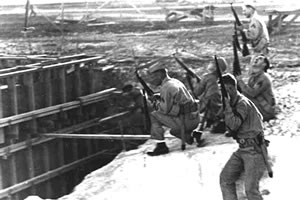
Bond and his supporters, including Barbers Point Naval Air Museum at Barbers Point president Brad Hayes, recently discovered an unfinished swimming pool at the airfield from where Marines fired 1906 Springfield rifles during the attacks.

“The big dogfight you see in Pearl Harbor movies, that actually happened here,“Bond attested.“There are a lot of other people assisting me with help and support. I’m carrying the flag publicly by letting people know what’s going on.”

The Navy and Ford Island Properties, a division of the Hunt Development Group, are currently negotiating a development deal for the Ewa field land. The Navy owns the land and plans to lease 499 acres to FIP for 40 years. Originally, FIP gave the Navy land on Ford Island to build civilian residential units. After the deal fell through because of concern about building residences on an active military base, the Navy agreed to give FIP the Ewa field land.

The Navy conducted a cultural resource inventory survey and concluded the Ewa Marine Corps Air Field was excess land, which was officially made part of the Barbers Point airfield in 1997.

 In related news, a deal was finalized June 19 for Ka Makana Ali`i, a new West Oahu shopping center that will be located on land across from the Ewa field. The complex is anticipated to be larger than Pearlridge Center and will include a hotel. Bond feels this makes the Ewa field land all the more valuable to FIP/Hunt Development Group.

“They specifically wanted this land and wanted to try to get around this federal law requirement to do historical surveys,” said Bond.“They intentionally tried to depress the historic value of the site. We have a lot of help coming from former Marine Corps officers and veterans

While he disagrees with the Navy over the development of the Ewa field land, Bond said he is not against the Navy as a whole, or the rest of the U.S. military branches.

“I grew up here as a kid from a military family,“said the Kailua High School graduate.“I moved out here a few years ago (because) Dec.7 and Pearl Harbor seemed to be becoming part of my life. It’s an amazing, deep, historical subject. It is really, really fascinating.”