Friday, July 5, 2013

Fort Barrette and 'Ewa Field hold memorial observances Sunday


Fort Barrette and 'Ewa Field hold memorial observances Sunday


Kapolei - A little-known and almost forgotten part of Pearl Harbor Day history will be honored tomorrow at 8:00 and 10:00 am with with observances planned at Fort Barrette and at the nearby Marine Corps 'Ewa Field.

Service members were killed at both Kapolei locations in the surprise Japanese attack on December 7, 1941.

Cpl. Joseph A. Medlen was killed in a straffing run at Fort Barrette. He was a railway engineer at the coast defense gun emplacement, and was hit as soldiers at the fort tried to cover the big guns so they wouldn't be bombed.

Due to the number of aircraft on the ground that morning, `Ewa Field may have actually been the first site attacked by the Japanese on Dec. 7.

There were nearly 50 aircraft lined up when the attack came. Most were damaged or destroyed in strafing passes by the Japanese.

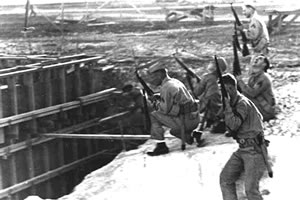
The site also has an unfinished swimming pool, from which the Marines defended the field with 1906 Springfield rifles.

The dogfight made famous by so many Pearl Harbor movies actually took place over `Ewa Field.

At 8:00 am an observance will be held at Fort Barrette, off Fort Barrette Road.

A Wai'anae High School ROTC color guard will honor the single Dec. 7 loss there.

Between ceremonies, privately-owned military vehicles will lead a convoy from Fort Barrette to 'Ewa Field. The route will follow Fort Barrette Road to Roosevelt Avenue to Corregidor Road.

At 10:00 am the `Ewa Field ceremonies will begin. Four Marines died at 'Ewa Field, as well as civilians.

Pearl Harbor Day survivors expected to attend the observance are John Hughes, a Marine who defended 'Ewa Field on Dec. 7, 1941, and Ray Emory, a Pearl Harbor survivor.

Daniel Martinez, chief historian for the USS Arizona Memorial and larger World War II Valor in the Pacific National Monument, will be the speaker.

'Ewa Beach historian John Bond organized both observances. Bond told the Honolulu Advertiser that he decided to hold the observances the day before the big Pearl Harbor commemoration so there wouldn't be a conflict. Both events tomorrow are open to the public.

World War II and military law in Hawai`i made significant chances to the social structure of the Islands, and brought Hawai`i to the attention of the world.


Ewa Field photos reveal damaging evidence

Ewa Field photos reveal damaging evidence

by John Bond    Save Ewa Field

1925 photos of Ewa Mooring Mast Field prior to construction indicate archeological evidence of significant numbers of coral karst sinkholes which possibly could contain Hawaiian burial remains.
   
 I have also seen currently existing coral karst sinkholes very nearby with very old Ti plants growing out of them, indicating some Hawaiian cultural activity in the past.
This is in an area directly adjacent to areas Hunt Corp, which leases land from the Navy, is now having bulldozed and uprooted (“grubbing?”) for new commercial lots in an area that has been defined as a National Register eligible Ewa Field warehouse district according to a survey just done this year.
Glenn Oamilda of the 50-year-old Ewa Beach Community Association and Section 106 Consultant to the current Navy-Hunt KREP-Ewa Field development plan under 106 review, believes that this area likely contains an underground karst water system as well as possible Hawaiian burial remains.

It is of especially great concern because this current work has been going on at odd hours and at night. The large machinery doing this work has been piling up large amounts or coral rocks and beach sand, as well as very large tree trunks pulled out of the ground.

This does not seem to fit the allowed “grubbing” activity that is supposedly permitted without a Section 106.

Mike Lee, a living descendent of Hawaiian royalty, has been asked to become a community consultant on this on going damage of heavy equipment digging and leveling in the Ewa Field area, and after reviewing the 1925 Ewa Mooring Mast pre-construction photos has great concern about damage that may be done to possible cultural and Hawaiian burial sites that likely exist just below the surface.

The 1941 Ewa Field Command History speaks of caverns as large as railway boxcars that had to be filled up with beach sand in many cases from nearby beach dunes, which have been known to also contain Hawaiian bones and artifacts.

Lee and Glenn believe that the Ewa Field area is part of a contiguous Hawaiian burial area linked to the significant Onelua beach burial and heiau area directly to the south of this Ewa Field area.

Where Hunt Corp is currently bulldozing and clearing it is exposing sand and coral rock, which can also be clearly seen in the overhead GIS attachment.

Part of the area they are clearing isn’t even on their leased parcel. The Navy is apparently allowing them to do this.

Hunt Corp has just recently allowed a TV film crew to use 1943 Quonset Hunt 1545 (which really wasn’t on their leased property) and now inspection reveals missing windows, door, a large World War II building 1545 sign designation and two large holes cut into the side of the building for film cameras.

This seems to be a very typical of the pattern—a constant chipping away of historic structures to satisfy a goal of “no integrity” which Hunt and the Navy share as a development objective.

Before the Quonset hut they knocked down the landmark 1943 Ewa Field Squadron Wall along Roosevelt Avenue without any public input or notice. Hunt apparently believes that no one can stop them from continuously damaging everything that is of historic value at Ewa Field.

The Navy is doing nothing to prevent this from happening. We can only record their on going damage after they have done it. The State Historic Preservation Division doesn’t seem to care either anymore.

John Bond
Save Ewa Field


Ewa Field Battlefield Survey Report released by Navy

Ewa Field Battlefield Survey Report released by Navy

by John Bond

The Ewa Field December 7 Battlefield could become a recognized National Battlefield, National Landmark and major new West Oahu visitor attraction 


A public meeting will now finally help bring the Save Ewa Field mission to an official Federal Section 106 Public hearing. The Pearl Harbor attack of 1941 remains today as the single GREATEST visitor attraction for Oahu.  All of the other major Pearl Harbor attack sites have become National Landmarks, but they are all on Military Bases.  This is the FIRST NEW recognized Pearl Harbor battle site and it is in West Oahu.


A recognized Ewa Field Historic Park could bring thousands of visitors to Ewa-West Oahu as part of a Pearl Harbor tour program and part of the National Park Service WW-II Valor In The Pacific monument. The Hawaii State Legislature as well as three neighborhood boards voted in 2009 for the preservation of Ewa Field as a park, museum site, memorial landmark and national battlefield. Pearl Harbor historian Daniel Martinez has called Ewa Field "Hallowed Ground" because of the US Marines killed in action there. Hundreds of veterans, citizens and remaining Pearl Harbor attack survivors have attend our annual Save Ewa Field events.


Ewa Field Battlefield Survey Report:

Lots of specific Ewa Field information for Dec. 7 historians in this PDF- many aspects covered- including runways, buildings, railway line, horse stables and much more. The "integrity" is skewed towards the Hunt Corp agenda of LEAST PRESERVATION- but reading the actual survey report tells a lot more and says the survey is just "preliminary." A LOT MORE research and survey documentation is needed, say the report authors for this very significant December 7 Battlefield.


A few selected random bits...

1.1.4: EWA FIELD BATTLEFIELD BOUNDARY Based on the battlefield defining features identified through military terrain analysis above, the core area of the Ewa Field battlefield encompasses approximately 180 acres, including the extent of the installation’s aviation and camp areas in 1941. This boundary is shown in Figure 1 (p. 25), and includes all the areas known to have been directly involved in combat. This is the area addressed in the integrity evaluation that follows. Several areas of strafing mark groups have craters in the concrete much larger than that made from the 7.7mm bullets of the Japanese machine guns. These craters are of variable width, from about 4" to about 12" across and about 2½" deep, and may have been made by the projectile of a 20mm cannon from a Japanese Mitsubishi A6M "Zero" fighter. This aircraft had 2- 20mm cannons (Oerlikon Type FF cannons firing 20x72rb cartridge) mounted in the wings along with 2- 7.7mm machine guns in the fuselage. A record of this damage (possible bullet marks and spalling) to the concrete aircraft warm-up platform was made during the fieldwork for this report and is included in Appendix A of this report.

A Japanese Val pilot after the war related:
"After bombing the battleship we looked down on Ford Island and strafed the airfield (at Ewa) as instructed. After that we evacuated toward the sea off Honolulu (Ewa). There we circled and waited for the others to show up. Just then we were followed and attacked by a P-40 enemy fighter plane."

"Pilot Gotoh of the No.1 plane of (an) Akagi carrier bomber (shotai), which had participated in the attack with us, engaged one of these P-40s in an air duel. Both ended up shooting each other down off Honolulu (Ewa). The enemy plane went down and so did ours. Because we had observed the air duel both were credited with a plane shot down."
The fighter aircraft were Mitsubishi A6M, named "Zero" or "Zeke" by the US. These aircraft were armed with two, forward firing 7.7mm machine guns in the fuselage and two, 20mm cannon in the wings firing a 20 x 72rb round. This was an early type of 20mm cartridge, of relatively lower power than later 20mm rounds, firing its projectile at about 1900 feet/ second velocity. Zeros were capable of carrying 60kg bombs, but were not armed with bombs that day. These fast and nimble aircraft would have been able to strafe ground targets at Ewa Field.

On the morning of December 7, 1941 several mobile batteries (with 3" guns) were set up and ready to fire between 10 and 11 am. One mobile battery was ready at Fort Weaver at 11:45 am. .30 cal. machine gun units and fixed 3" guns at Fort Weaver were quickly readied and began engaging the attacking aircraft at 8:14 and 8:30 am (Gaines 2001, 46). Another cadre of men at a fixed battery at Fort Barrette opened fire with small arms before the battery was ready to fire (Gaines 2001, 46). A regiment of Coast Artillery at Camp Malakole, near Barber's Point, had moved into their positions at West Loch and near Ewa and were ready to fire at 11:45 am.

Guards at Camp Malakole had shot down a strafing Japanese plane at about 8:05 am with small arms fire (Gaines 2001, 47). The Navy's Fleet Machine Gun Training School at Fort Weaver began firing machine guns and 20mm cannon at 8:10 and are credited with downing four Japanese aircraft.

After the attack, maps that were found on the bodies of downed Japanese aviators showed that the attackers had a very accurate picture of the location of US gun batteries on Oahu (Williford 2003, 40).

The surviving Quonsets huts at Ewa Field are evaluated here in light of this recent change in how Quonsets are viewed and are considered potentially eligible for the National Register. Other structures at Ewa Field can be considered potentially eligible. A cluster of former warehouses at the corner of Coral Sea Road and Roosevelt Avenue could be eligible as a district or thematic grouping, and an aircraft hangar and compass rose have direct ties to the core aviation function of Ewa Field and are also potentially NR eligible.


2.4.3: EWA FIELD AIRCRAFT REVETMENT HISTORIC DISTRICT The approximately 75 extant vaulted concrete aircraft revetments south of the airfield that were constructed ca. 1942-43 have been evaluated in previous studies and are considered eligible for the National Register as a district for their association with the development of Ewa Field during World War II. Although some of the revetments are currently used as horse stables, all aspects of their integrity are retained (setting is partially retained due to infill horse corrals and vegetation growth).
---30---


'Forgotten' Sacrifice Honored In West Oahu


75th Anniversary Ewa Field Is Still Alive With History

This historical photo

75th Anniversary

Ewa Field Is Still Alive With History

By Kerry Miller  

Dec. 7, 1941, is one of the most memorable dates in Hawaii’s history, with the attack on Pearl Harbor forever imprinted in the minds of those who experienced it.

After much historical research, John Bond discovered the Ewa Marine Corps Air Field - located just off Geiger Road near the Barbers Point airfield - to be a place of importance during this time. Now the Ewa Beach resident and historian is fighting the Navy and a development company to get the former air field on the National Historic Register.

“The main thing is when the attack on Pearl Harbor was first happening, planes came down the coastline of this area of Barbers Point. This was their whole rendezvous rotation point,“said Bond.“Japanese Zeroes, they came into the airfield, and so this spot was being attacked before Pearl Harbor was even bombed.

We believe it was one of the very first spots attacked on Dec. 7.

“Civilians were killed out here. None of this story out here has ever been well-presented as part of the whole Pearl Harbor thing. Basically, the airfield has been totally ignored, historically, as an important battle site.”
 
Bond and his supporters, including Barbers Point Naval Air Museum at Barbers Point president Brad Hayes, recently discovered an unfinished swimming pool at the airfield from where Marines fired 1906 Springfield rifles during the attacks.

“The big dogfight you see in Pearl Harbor movies, that actually happened here,“Bond attested.“There are a lot of other people assisting me with help and support. I’m carrying the flag publicly by letting people know what’s going on.”

The Navy and Ford Island Properties, a division of the Hunt Development Group, are currently negotiating a development deal for the Ewa field land. The Navy owns the land and plans to lease 499 acres to FIP for 40 years. Originally, FIP gave the Navy land on Ford Island to build civilian residential units. After the deal fell through because of concern about building residences on an active military base, the Navy agreed to give FIP the Ewa field land.

The Navy conducted a cultural resource inventory survey and concluded the Ewa Marine Corps Air Field was excess land, which was officially made part of the Barbers Point airfield in 1997.

 In related news, a deal was finalized June 19 for Ka Makana Ali`i, a new West Oahu shopping center that will be located on land across from the Ewa field. The complex is anticipated to be larger than Pearlridge Center and will include a hotel. Bond feels this makes the Ewa field land all the more valuable to FIP/Hunt Development Group.

“They specifically wanted this land and wanted to try to get around this federal law requirement to do historical surveys,” said Bond.“They intentionally tried to depress the historic value of the site. We have a lot of help coming from former Marine Corps officers and veterans

While he disagrees with the Navy over the development of the Ewa field land, Bond said he is not against the Navy as a whole, or the rest of the U.S. military branches.

“I grew up here as a kid from a military family,“said the Kailua High School graduate.“I moved out here a few years ago (because) Dec.7 and Pearl Harbor seemed to be becoming part of my life. It’s an amazing, deep, historical subject. It is really, really fascinating.”


75th Anniversary Ewa Field Marines among first to battle Japanese

 75th Anniversary

Ewa Field Marines among first to battle Japanese

By Sgt. Juan D. Alfonso
 
EWA, Hawaii -- Sixty eight years ago, four Marines gave their lives and were among the first American casualties of World War II. They witnessed the advance of Japanese bombers moments before the attack on Pearl Harbor. They struggled to save burning aircraft and fired at the enemy whenever the opportunity presented itself.

Active and retired service members, state officials and members of the community gathered Dec. 6 to honor those Marines at the first Marine Corps Air Station Ewa Memorial at Ewa Field.

What used to be the hub for all Marine aviation units preparing for combat in the Pacific today lies in ruins. The poorly kept flight line is riddled with weeds growing from numerous cracks surrounded by dense shrubbery, a fact many World War II historians would like to change.

“There is a lot more important history that happened out here than most are aware of,” said John Bond, event coordinator and an avid World War II historian. “Not only was Ewa Field attacked but several aircraft were shot down (in Ewa’s airspace). The movies always depict battles only over Pearl Harbor but that’s not how it happened. The Ewa area saw the bulk of the true air-to-air combat of the attack.”

During the ceremony, numerous officials, to include Hawaii State Senators Mike Gabbard and Will Espero, recounted praise from Japanese pilots during the attacks stating, “These were the bravest soldiers (the Japanese) had ever encountered.”

But some of the most compelling stories came from MCAS Ewa survivor retired Maj. John Hughes. Hughes, the only survivor present at the ceremony, recounted what he witnessed Dec. 7, 1941.

Hughes, a Marine sergeant at the time, was waiting for the newspaper that morning when he witnessed Japanese aircraft flying over the airfield headed toward Pearl Harbor. He immediately ran to the guard house and ordered his Marines to start “breaking out ammo.”

He and the Ewa Marines began firing at enemy aircraft as they flew by. 

“I got off a few rounds, maybe three shots then started (moving) the planes,” he said “Some planes were on fire and we moved the other ones to save as many as we could. We’d fire a few shots, go back to pushing planes and then go back to firing.”

At the end of the two-hour conflict, 12 Marines were wounded and four had perished.

Bond and numerous officials plan to make the ceremony an annual event and are in the process of making the area an official historical battle site and hope to one day build a museum on the unused field.

“It’s important that the people out in West Oahu know there was a historic battle out here,” Bond said. “Many people believe the area should be preserved for future generations. Civic organizations, neighborhood boards, the State House and Senate have all passed resolutions to make that possible and that’s what we are going to do.”

 PHOTOS

 Marines retire the colors at the conclusion of the first Marine Corps Air Station Ewa Memorial Dec. 6 at what remains of Ewa field. MCAS Ewa could be the spot where U.S. service members first fired during WWII, according to John Bond, the event coordinator and avid WWII historian. (Official U.S. Marine Corps photo by Sgt. Juan D. Alfonso) (Released)


'Forgotten' Sacrifice Honored In West Oahu


75th Anniversary of Pearl Harbor: Ewa Field, Ewa Village, Hawaii took Zero fire, too

 75th Anniversary of Pearl Harbor:

Ewa Field, Ewa Village, Hawaii took Zero fire, too

An airfield gets its due during a ceremony recalling Dec. 7, 1941

By Dan Nakaso

Kiyoshi Ikeda ran to his home in Ewa Villages when he saw the Japanese attack on Pearl Harbor 69 years ago and was closing the door to his kitchen when a Japanese fighter pilot fired a round that landed two feet from him.

"Bakatare!" Ikeda yelled back at the pilot as other Japanese Zeros were already strafing Ewa Field just a mile from Ikeda's home, killing four Marines and wounding 11 more in three waves of attack, according to the 14th Naval District Command history.

Yesterday, Ikeda returned to the abandoned and weed-covered remains of Ewa Field for a sunny ceremony honoring one of the lesser-known sites of the Japanese attack that propelled America into World War II.

The ceremony was one of several held over the last few days that lead up to tomorrow's Dec. 7 commemoration.

World War II historians at the old Ewa Field yesterday wanted to honor the actions of the Marines that day -- and to bring attention to the forgotten airfield, which had once been the hub of Oahu military flight operations on the Ewa plain.

It drew modern-day Marines who presented the colors, along with historians from the Hawaii Historic Arms Association and Hawaii Military Vehicle Presentation Association who stood in for World War II-era sailors, soldiers and Marines and wore World War II-era uniforms.

The groups also brought an M-1943 Willys Jeep, an M-2-4 International 1 1/2 -ton truck, a 1944 WC51 Dodge three-quarter-ton truck and a 1943 Ford M20 armored utility car to give the event more World War II authenticity, said Jeffrey Wang, president of the Hawaii Military Vehicle Presentation Association and a board member of the Hawaii Historic Arms Association.

Before it was renamed Ewa Marine Corps Air Station, Ewa Field was carved out of a 3,000-by-3,000-foot patch of sugar field to tether dirigibles in the 1920s, according to Navy history.
On the eve of the Japanese attack, an estimated 700 Marines were stationed at Ewa Field, whose landing strip was designed like an aircraft carrier flight deck for Marine Air Group 21, which flew fighters, tactical bombers and scout planes.

Ikeda was a 14-year-old freshman at Waipahu High School and had gotten used to U.S. pilots making touch-and-go landings on the mock carrier flight deck day and night.

So when he saw Japanese Zeros flying overhead on Dec. 7, 1941, Ikeda assumed they were Americans training for battle.

Then he saw the attack unfold over Pearl Harbor and ran home, only to be shot at by a plane bearing an unmistakable red circle on its wings and body.

While five or six Japanese bullets pierced his neighborhood and one landed near Ikeda's feet, another Japanese fighter pilot merely waved harmlessly at another boy in the neighborhood, Ikeda said.
"I don't know why but that pilot shot at me," Ikeda said.

Single-seat Japanese fighter planes began the first attack on Ewa Field at 7:55 a.m., firing incendiary, explosive and armor-piercing 7.7 mm and 20 mm rounds in low-level strafing runs over Runway 1 1/2 9, according to the Navy.

By the time the first attack ended at 8:20 a.m., the Zeros had destroyed or damaged tactical bombers and fighters parked on Runway 11's tie-down area and warm-up platform, according to the Navy.
Zero pilots also killed the officer of the day as he tried to call the camp to arms from the Ewa Gate guardhouse, according to the Navy.

The second and third attacks lasted from 8:35 to 9:15 a.m. and consisted of heavy strafing by rear gunners flying in Japanese dive bombers and torpedo planes that were retreating from the Pearl Harbor attack.

The Japanese tail gunners killed three Marines who were firing back from disabled planes, according to the Navy, and wounded 11 other Marines who were trying to extinguish U.S. planes burning along the flight line.

Ikeda was not old enough to join the all-nissei 442nd Regimental Combat Team or the 100th Battalion that were formed after the Japanese attack, but he showed up at yesterday's ceremony at Ewa Field because the events of Dec. 7 had a profound effect on the rest of his life.

Ikeda went on to a career as a sociology professor at the University of Hawaii but was forever touched by the efforts of the Americans who joined the fight after the attack on Pearl Harbor and the lesser-known battle of Ewa Field.

"It developed a model for me of what a good citizen should be," Ikeda said.


75th Anniversary: Heroes at Hawaii's Ewa Field defended against Japan attack


75th Anniversary:


Heroes at Hawaii's Ewa Field defended against Japan attack

By John Windrow  Advertiser Staff Writer


'EWA — Sixty-eight years ago today, the United States entered one of the bloodiest struggles of its history, the war in the Pacific.

About 200 people gathered yesterday at a cracked, potholed, weedy strip of concrete at 'Ewa Field, where part of the opening salvo in that long, brutal fight was fired.

'Ewa Field has a history that time has obscured. When the carrier-launched warplanes of the Japanese Empire roared in to attack Pearl Harbor, they also hit the Marine Corps Air Station in 'Ewa, where several hundred Marines were stationed and nearly 50 aircraft were on the ground at 'Ewa Field. Four Marines and two civilians at nearby 'Ewa Plantation were killed, one of them a 6-year-old girl.


In two strafing waves and other sporadic attacks, Japanese planes destroyed or damaged most of the aircraft on the tarmac. None got into the air. Machine gun and 20mm strafing gouges and burn marks can still be seen on the concrete area where the planes were tied down.

'Ewa Beach historian John Bond, who is spearheading efforts to preserve the battle site, said the attack at 'Ewa Field may have preceded the Pearl Harbor bombing by a few minutes. So it is possible that the first U.S. shots fired at Japanese forces in World War II were at 'Ewa Field.

Those on hand yesterday, mostly veterans, military members and public officials, heard speeches about the sacrifice of American lives to preserve liberty. They paid tribute to the deserted place where they had gathered, the speakers said, sacred ground defined by the loss of American blood, where others had fallen so they could stand for liberty.

During the ceremony, wreaths were laid, a bugler played taps, a color guard marched onto the field, and Marines fired a 21-gun salute to honor the spot called a cornerstone of local and national history.

One of the men who squeezed off a few rounds that Sunday morning was on hand for yesterday's ceremony.

BREAK OUT THE AMMO

John Hughes, 90, a retired Marine major from Orange County, Calif., said he was sitting at 'Ewa Field waiting for the morning newspaper when: "I looked up and saw planes with a red ball on the side and a torpedo underneath flying low over the mountains. I knew what that meant, and I ran for the guard shack and told them to start breaking out ammo."

Hughes, who enlisted in the Corps in 1937 at the age of 18, was a sergeant when he was stationed on O'ahu in 1941.

He said he ran to the barracks, roused the troops and passed out belts of ammunition. The men were armed with 1903 Springfield rifles.

"I got off a few rounds, maybe three shots," Hughes said. "Then we would start moving the planes. Some planes were on fire and we moved the other ones away from them so they wouldn't explode. We'd fire a few shots and then move the planes. Then go back to firing shots."

He said the attack lasted for about two hours.

After the Pearl Harbor attack, Hughes trained to be a pilot at Pensacola Naval Air Station in Florida. At the time, enlisted men could serve as Marine pilots.

He said he flew 150 missions in the Philippines and the Solomon Islands as a dive-bomber pilot in World War II and was a helicopter pilot in the Korean War. The Distinguished Flying Cross is among his decorations. He retired from the Marine Corps in 1964.

Hughes was never wounded. "That wasn't my job," he said grinning. "My job was to do that to the other guys."

Daniel Martinez, chief historian of the USS Arizona Memorial, told the crowd that 'Ewa Field was the birth of Marine aviation in the Pacific "and that is why this place is important."

Some of the forces that helped turn the tide of the Pacific War at the Battle of Midway had been at 'Ewa Field, Martinez said, and it was "the last piece of American territory where they set foot on American soil, before they sailed off into history to give their lives for their nation and become part of our national memory."

Hughes, who stood on that field so long ago with his bolt-action Springfield taking on Zero fighters spewing machine gun fire, will be at today's much larger ceremony at Pearl Harbor.

"He appreciates the ceremony, the ritual," said his daughter Nancy, who made the trip to Hawai'i with her father, "because it keeps history alive."